In practice, when implementing commercial projects, material selection has gone well beyond mere aesthetics or style. It is a decision-making process based on controlling costs, efficiency in implementation, and the overall performance of the materials chosen. For developers, general contractors, and design teams, the perfect choice of stone should be one that can consistently deliver.
In this context, quartz vanity tops have become the mainstream choice for hotels, apartments, and multi-residential projects. Compared to traditional natural stone, quartz offers more than aesthetic consistency but also greater benefits in terms of manufacturing accuracy, quick installation, and maintenance. In particular, when it comes to large construction projects, the appeal of quartz is in the "systematic application" of the material.
The PMC2839GJ project, produced by Cambodian Zulite Stone, serves as a strong case study. By applying quartz to both kitchen countertops and bathroom vanities, the project utilized a unified material system and standardized fabrication to achieve highly efficient synergy from design to final delivery.
In large-scale developments involving hundreds or even thousands of units, "risk mitigation" is the core objective. Unlike the subjective material selection found in the residential retail market, commercial decision-making is a calculated balance of cost, efficiency, and long-term operations. The rise of the white quartz vanity top represents an evolution of building materials from "natural randomness" toward "industrial standards."
While natural marble is highly susceptible to corrosion from acidic cleaners and prone to irreversible staining in busy restrooms, quartz provides a near-zero-porosity physical barrier. This is critical for bathroom vanities quartz top applications—for property owners, minimal maintenance requirements and superior hygiene performance are the baseline for reducing O&M costs and ensuring asset preservation.
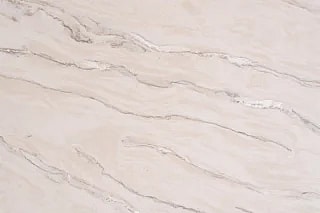
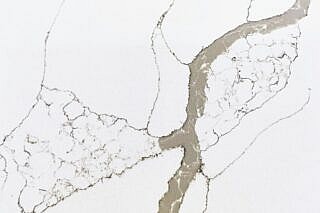
The design intent behind PMC2839GJ was to capture the "fluid soul" of natural stone. As a premium Calacatta quartz slab, it features a warm white base with gray veining that feels organic and breathable, achieved through precision engineering.
This design provides architects with the refined aesthetic of premium Calacatta marble while being engineered to overcome the inherent physical limitations of natural stone. With a Mohs hardness surpassing most natural stones, these surfaces withstand high-frequency use in environments such as luxury hotels or Grade-A office buildings, remaining resistant to scratches and impacts. For commercial buyers, this secures the project’s long-term resale potential and rental yields.
In commercial projects, visual continuity is the cornerstone of quality. Natural stone often suffers from grain discontinuities or significant color variations, which can lead to increased time costs during secondary selection.
The core value of PMC2839GJ lies in its controlled industrial production. Utilizing advanced distribution technology, our surfaces maintain high stability in both base tones and vein distribution. This translates to:
Based on the concept of total cost of ownership, while the initial procurement cost is competitive, the real advantage that quartz offers is its "low-holding cost." Natural marble requires expensive professional sealing and grinding at regular intervals; the PMC2839GJ quartz, with its dense, non-porous structure, can easily maintain its luster. In a commercial environment where labor costs continue to rise, this "maintenance-free" attribute is a vital tool for project stakeholders to improve long-term profitability.
In commercial projects, high-quality slabs are merely the foundation. The true determinant of the final delivery effect is the fabrication precision and the execution system behind it. In the PMC2839GJ project, our focus shifted from visual performance to the stability of large-scale delivery.
The PMC2839GJ project embodies a systematic production logic tailored for high-volume engineering. When a project scales from a few units to hundreds, the true challenge is ensuring that every single unit maintains consistent quality throughout its spatial application.
For the PMC2839GJ project, a large percentage of work has been done at the factory, including sink cutouts, faucet openings, and necessary installation notches. This is a major move that helps to transfer labor from the job site, creating a workflow that aligns more closely with modular assembly:
In the PMC2839GJ project, the decision to adopt a uniform R2 radius edge reflects a deep consideration of commercial usage logic. While sharp square edges are popular in modern design, they are highly prone to chipping. The R2 edge offers a "refined middle ground"—maintaining a clean profile while significantly increasing durability.
In the confined spaces of hotel bathrooms, sharp corners are a safety concern. A slightly rounded R2 edge is far more ergonomic for the end-user and helps mitigate potential long-term operational liability for property owners.
Furthermore, this edge profile enhances the success rate of the delivery chain. From factory crating to international shipping and site handling, an R2 edge is far more resilient to chipping than a square edge, ensuring the material arrives in expected condition.
For commercial projects, materials never exist in isolation. They influence not only the spatial presentation but also deeply participate in construction efficiency, operational costs, and long-term asset value.
As seen in the implementation of the PMC2839GJ project, the importance of quartz vanity tops is no longer determined by one particular indicator, but in the "controlled system" it carries—from color stability and pre-fabrication logic to the replicability of bulk delivery. As project scales expand and delivery cycles compress, the industry is no longer asking which material is the most "unique," but which solution is the most controllable. Under this logic, quartz is transitioning from an alternative material to the industry benchmark for projects where reliability and long-term ROI are the priorities.